Showing posts with label Festivities. Show all posts

Tuesday, 17 March 2015

Saint Patrick's Day


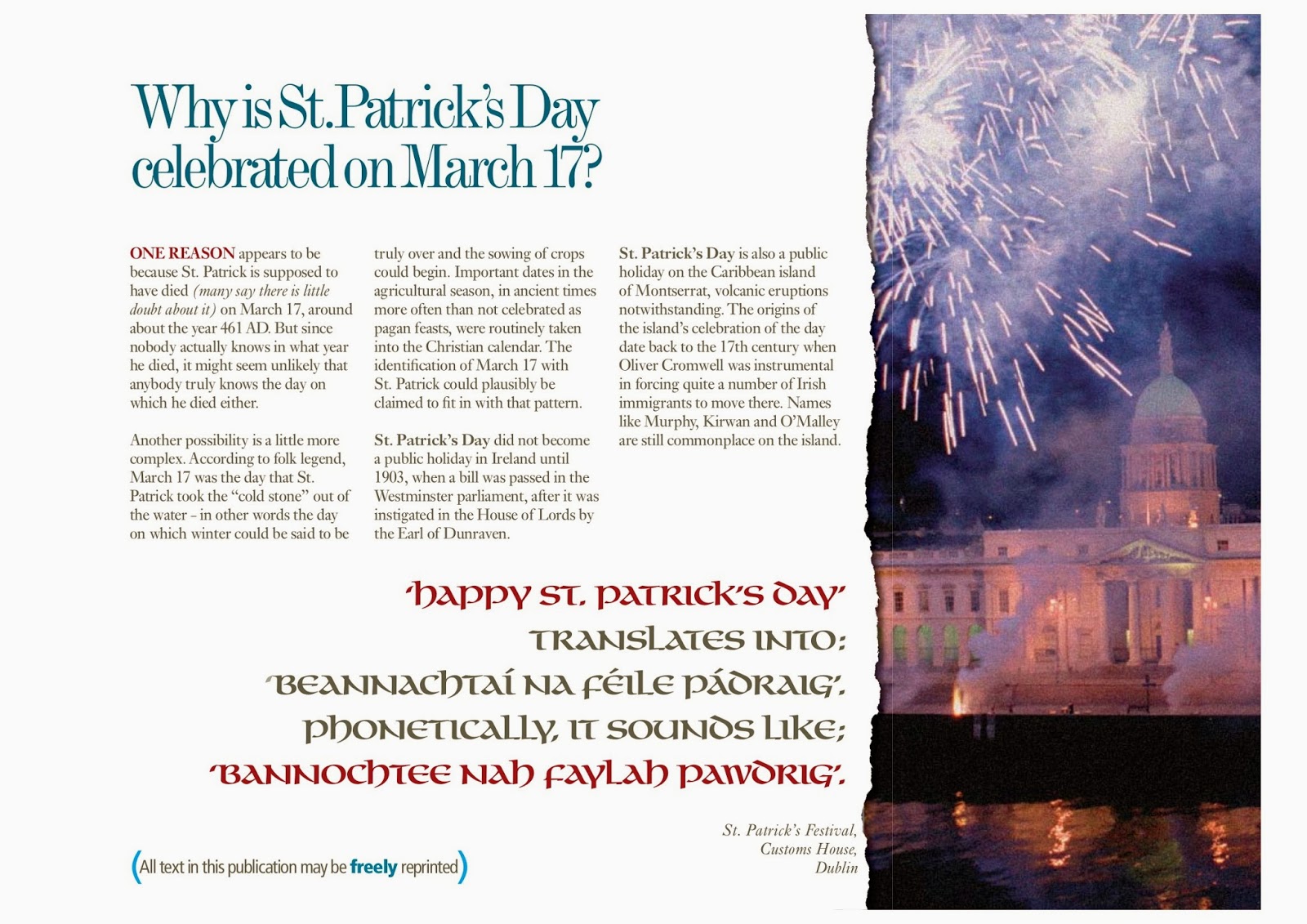
Reread last year's post for some info on this celebration and follow this link for some tasty St Patrick's Day recipes: www.tasteofhome.com


Sunday, 14 December 2014

Thursday, 27 November 2014

Thanksgiving & Black Friday

Thanksgiving 2014: November 27th


A typical Thanksgiving Day menu includes:

- Roasted turkey
- Stuffing
- Cranberry sauce
- Mashed potatoes
- Green beans
- Sweet potatoes
- Sweet corn
- Brussels sprouts
- Pumpkin pie


The National Football League (NFL) on Thanksgiving Day is a traditional series of games played during the Thanksgiving holiday in the USA. Currently, three NFL games are played every Thanksgiving.


The morning of Thanksgiving Day all eyes turn to Manhattan and the Macy's Thanksgiving Day Parade, an annual pageant of giant balloons, floats, cheerleaders, clowns, marching bands, Broadway shows and celebs. The parade begins at 9am and finishes three hours later at noon.


Black Friday is the Friday following Thanksgiving Day in the USA, often regarded as the beginning of the Christmas shopping season. In recent years, most major retailers have opened very early and offered promotional  sales to kick off the holiday shopping season.

Tuesday, 23 April 2013

World Book Day


World Book Day is a yearly event on 23 April, organized by UNESCO to promote Reading, publishing and copyright.
The connection between 23 April and books was first made in 1923 by booksellers in Spain as a way to honour the autor Miguel de Cervantes who died on that day.
In 1995, UNESCO decided that the World Book and Copyright Day would be celebrated on this date because of the Catalonian festival and because the date is also the anniversary of the birth and death of  William Shakespeare and the death of Miguel de Cervantes.
To celebrate this day Cervantes' Don Quixote is read during a two-day "readathon" and the Miguel de Cervantes Prize is presented by the King in Alcala de Henares.
In Catalonia, since 1436, St. George’s Day has been 'The Day of the Rose', where the exchange of gifts between sweethearts, loved ones and respected ones occurs. It is analogous to Valentine's Day. Although the World Book and Copyright Day has been celebrated since 1995 internationally, the first time that books where also exchanged in 'The Day of the Rose' in Catalonia was in 1926 to commemorate the death of Cervantes.


WILLIAM SHAKESPEARE
Stratford-upon-Avon - April 23rd, 1564
Stratford-upon-Avon - April 23rd, 1616


MIGUEL DE CERVANTES SAAVEDRA
Alcalá de Henares - September 29th, 1547
Madrid - April 23rd, 1616

Monday, 1 April 2013

April Fool's Day!


April Fools' Day is celebrated in many countries on April 1st every year. Sometimes referred to as All Fools' Day, April 1st is not a national holiday, but is widely recognized and celebrated as a day when people play practical jokes and hoaxes on each other.
In Italy, France and Belgium, children and adults traditionally tack paper fishes on each other's back as a trick and shout "April fish!" in their local languages.
In Scotland, April Fools' Day is traditionally called Hunt-the-Gowk Day ("gowk" is Scots for a cuckoo or a foolish person), although this name has fallen into disuse. The traditional prank is to ask someone to deliver a sealed message requesting help of some sort. In fact, the message reads "Dinna laugh, dinna smile. Hunt the gowk another mile". The recipient, upon reading it, will explain he can only help if he first contacts another person, and sends the victim to this person with an identical message, with the same result.
This day is equivalent to the one we, Spaniards, celebrate on December 28th (Day of the Holy Innocents – Día de los Santos Inocentes).
See you tomorrow. Spring break is over! And that’s not a hoax!

Thursday, 14 February 2013

Happy Valentine's Day!

How to say I Love You in....


           German: Ich liebe dich

  Arabic: Ana behibek 

  Bulgarian: Obicham te
Mandarin Chinese: Wo ai ni

  Catalan: T’estimo

  Czech: Miluji te


Danish: Jeg Elsker Dig
  Finnish: Mina rakastan sinua

  French: Je t’aime
Gaelic: Ta gra agam ort

  Welsh: Rwy’n dy garu di

  Galician: Quérote


Dutch: Ik hou van jou


  Hungarian: Szeretlek

  Spanish: Te quiero  Italian: Ti amo


Icelandic: Eg elska tig

  Japanese: Aishiteru

  Norwegian: Jeg Elsker Deg

Polish: Kocham Ciebie

  Portuguese: Eu te amo


  Russian: Ya tibyá liubliú
Swedish: Jag alskar dig


  Turkish: Seni Seviyorum

  Basque: Maite Zaitut


And remember..... it's not necessary to be in love to say I Love You!

Tuesday, 21 February 2012

It's Pancake Day!!

Shrove Tuesday, also known as Pancake Day, is the day preceding Ash Wednesday, the first day of Lent. Shrove Tuesday is observed mainly in English speaking countries, especially Ireland, the United Kingdom, Australia, New Zealand and Canada, but it's also observed in other countries (Germany, Sweden, the Philippines, etc.). Shrove Tuesday is linked to Easter, so its date changes on an annual basis.

In most traditions the day is known for the eating of pancakes before the start of Lent. Pancakes are eaten as they are made out of the main foods available: sugar, fat, flour and eggs, whose consumption was traditionally restricted during the ritual fasting associated with Lent.

RECIPE (for 8 pancakes)

- 1 large egg or 1 egg and one yolk.
- 280 ml of milk
- 110 gr of plain flour (4 heaped dessertspoons)
- 1 tablespoon of melted butter
- a pinch of salt

Sift the flour into a bowl and make a well in the middle. Break in the egg (and yolk, if using) and add a pinch of salt and a splash of the milk. Whisk the egg, gradually incorporating the flour, to make a smooth cream. Whisk in the rest of the milk and the melted butter.

Now watch the video:

Saturday, 29 October 2011

Happy Halloween

Halloween is an annual holiday observed on October 31st, which commonly includes activities such as trick-or-treating, attending costume parties, carving jack-o-lanterns, bonfires, apple bobbing, visiting haunted attractions, playing pranks, telling scary stories and watching horror films.

A bit of History

Halloween is typically linked to the Celtic festival of Samhain, whose original spelling was Samuin. The name of the festival historically kept by the Gaels and Celts in the British isles is derived from Old Irish and means roughly "summer's end".

According to the Oxford Dictionary of English Folklore: "Certainly Samhain was a time for festive gatherings, and medieval Irish texts and later Irish, Welsh and Scottish folklore use it as a setting for supernatural encounters, but there is no evidence that it was connected with the dead in pre-Christian times, or that pagan religious ceremonies were held".

The Irish myths which mention Samhain were written in the 10th and 11th centuries by Christian monks. This is around 200 years after the Catholic church inaugurated All Saints Day and at least 400 years after Ireland became Christian.

Around the world

Halloween isn't celebrated in all countries and regions of the world, and among those that do the traditions and importance of the celebration vary significantly. In Scotland and Ireland traditional Halloween customs include children dressing up in costume going "guising" and holding parties, while other practices in ireland include lighting bonfires and having firework displays.
Mass transatlantic immigrations in the 19th century popularized Halloween in North America, and celebration in the United States and Canada has had a significant impact on how the event is observed in other nations. This larger North American influence, particularly in iconic and commercial elements, has extended to places such as South America, Australia, New Zealand, continental Europe, Japan and other parts of East Asia.

Thursday, 6 January 2011

Wednesday, 27 October 2010

The history of Halloween

Here you are a video on the history of Halloween by National Geographic Channel.